

Going Institutional: A Definition for the Crypto Natives
Institutional grade yes? Tell me more? Oh because you want BlackRock money and have some BD guys in NYC meetingmaxxing? Seems larp-y.
Written by: Alex Bell, Head of Partnerships at Hype
While others managed their teenage angst by joining a support group - the jocks and popular kids, the freaks and geeks, I didn’t go to a school big enough to support that rich of an ecosystem.
So, like a swashbuckling pirate sailing a hormonal sea, I wandered about until I found philosophy, and fell in love with Wisdom.

One of the very first things anyone who’s studied philosophy learns is that the key to understanding the world is in Definitions.
It’s asking “explain please: WTF are you actually on about bruv - what do you mean when you use that word?”
Defining your terms is the first step to actually getting at something real and not just floating through life in a haze of smoke and shadow.
I’m very cerebral; this idea of precise definition is easy for me to love
I’m also very heterodoxical; I love to challenge the status quo.
So when I see buzzwords flying around - my attention piques.
I appreciate social signalling. Sometimes we just drop a “gm” in the “gc” to let the “real ones” know we “stan” for them. These things don’t need mental gymnastics. In these moments, we’re just humans being humans.
But I also really hate when buzzwords become handwavy magic wands to try to gloss over something that’s actually important to understand more fundamentally.
For the swashbuckling philosophical teenager still alive in my heart, “Institutional-Grade” is potent crashout material.
Institutional grade yes? Tell me more? Oh because you want BlackRock money and have some BD guys in NYC meetingmaxxing?
Seems larp-y.
And I think doing a bit of Definition work can help us all, as an industry, take advantage of the maturation opportunity in front of us - without reducing ourselves to simping for Wall Street in exchange for a meager portion of hopium.
Instead of using “Institutional” as an aesthetic aspiration, status signal, or access narrative, the following is a proposal for Institutional that gives crypto companies and projects new and old, large and small, an ability to work to become Institutional in their own right.
And perhaps along the way, secure some BR bucks too.
The Definition
Here’s the proposal:
“In crypto, ‘Institutional’ describes behavior that arises where engagement is constrained by structural eligibility, downside survivability, and process maturity.
This contrasts with engagement logics that optimize primarily for speed, narrative flexibility, or upside maximization.”
For my brothers in Christ currently head spinning, fear not. Below we’ll unpack what any of that actually means in human language.
Big brain energy I know, allow me to explain
Alright so as I said above - the mission is to create a definition of “Institutional” that’s functional, something crypto projects of all shapes and sizes can leverage to outlast any bear by building a mature organization that isn’t dependent on negative PnLs from hype-cycle-fed noise capital.
Let’s look at the first couple of key concepts in the definition - Behavior and Constraint.
Behavior
The key to making this definition functional is to focus on “institutional behavior” rather than treating “institutional” as a category.
Meaning for our definition, “institutional” cannot simply mean:
Big Brand (BlackRock, Anchorage-type firms only)
Regulated-Only (Coinbase has behaved “Institutionally” for years without clear regs)
Conservative (Citadel takes quite a bit of relative risk to generate 15-20% returns)
When we root our definition of Institutional in behavior, we can look at a hedge fund punting a large percentage of AUM into a potential total loss position and say that’s not institutional.
Just as we can look at a DAO coordinating legal infrastructure to hold real world assets and operationally tie their disposition to a vote of any/all stakeholders and say that may in fact be institutional.
Constraint
As we start to think about what Institutional might mean in a behavioral sense, we can look at the organizations most of us would say actually are institutional - not to just make some ecosystem map for today’s viral KOL content, but to tease out what *kind* behavior could be said to be institutional in a general sense.
In doing this, what is especially notable in the context of crypto is that Institutional names like Anchorage, Coinbase, Van Eck, etc operate under binding structural conditions.
When crypto organizations operate institutionally, upside doesn’t compensate for constraint failure. The opportunity set is filtered before it’s optimized and key actions are chosen via organizational logic, not personal preference.
You might think CB has listed some crazy tickers, but their finance, legal, and compliance teams follow a defendable process, which is galaxies more than we can say for Pump bonded 1000x memers.
Pressures that constrain Institutions
The constraints that bind Institutional behavior emerge from structural pressures that we see consistently across TradFi and now some crypto-native organizations.
Three that dominate when we juxtapose “institutional behavior” to the various forms of “ape it all into the current runner behavior” we see across crypto.
1. External Capital Accountability
“Institutions” typically deploy others’ capital (LPs, Shareholders, Clients, etc), which creates:
fiduciary duty
mandate constraints
reporting requirements
audit trails
legal exposure
So decisions have to be defensible ex post, not just profitable ex ante.
When Other People invest their Money at institutional scale they want to know that, if you lose too much of it, they can at least figure out wtf happened and which heads will roll.
2. Organizational Continuity Preference
A key component of operating at Institutional-level trust and scale is a preference for robust organizational continuity.
The system can’t be overexposed to individual or small group personality dynamics and it has to be able to engage in review and survive handoff.
This creates pressure for:
documented processes
defined ownership
operational repeatability
decision legibility
resilience to turnover or scale
3. Asymmetric Downside Intolerance
Downstream from those two pressures, we see that Institutions tend to protect downside more than capture upside, even at their most degen.
Institutional decision makers are exposed to:
career risk
reputational risk
litigation risk
regulatory risk
So “Institutional Behavior” shifts toward bounded risk, reversibility, and survivability under scrutiny.
Identifying primary constraint groups
From these pressures, we see the emergence of the dominant behavioral constraints that we’ve included in our above definition.
These constraints, in engagement priority order, let us start to see which companies and projects in the ecosystem *act* institutionally whatever their surface appearance, as well as reveal gaps projects can fill to *become* more institutional regardless of their current shape/state.
External Capital Accountability -> Structural Eligibility
Because of the standards external capital enforces, Institutional actors require any significant external interaction, especially capital-related, to take certain shapes - otherwise they simply won’t be able to engage.
Thus, capital deployments/exposures must be:
legally holdable
mandate-compatible
custody compatible
deployable at scale
Asymmetric Downside Intolerance -> Downside Survivability
Because external capital requirements and organizational continuity preferences drive asymmetric downside intolerance, Institutions prioritize Downside Survivability over Upside Maximization.
This is managed by making exposures:
bounded
reversible
defensible under review
governance-controlled
Organizational Continuity -> Process Maturity
In order to satisfy external capital accountabilities, and as part of downside risk mitigation, Institutions not only build internal organizational continuity structures but also require them of partners they engage with at least to a degree.
Perhaps access control rigor and personnel management details don’t need to be as rigorously analyzed in an external party as they are internally.
These elements will still be reviewed as part of diligence, as the actual likelihood of loss or legal recourse is affected by whether there will still be some person to corner, some breach to demonstrate in the case of failure.
Thus, engagement relies on the external party having structure around:
defined ownership
operational repeatability
escalation paths
institutional-grade documentation
These contrast with Speed, Narrative Flexibility, Upside Maximization
Acting and engaging with other organizations by evaluating structural eligibility, downside survivability, and process maturity contrasts with behavior we’d typically associate with crypto’s “just ape in” ethos - which we’ve seen applied within protocol development teams just as with retail “investment” behavior.
This latter behavior is associated with traits like:
Speed - making product or organizational changes quickly (days/weeks vs months/quarters)
Narrative flexibility - frequently repositioning what the product is/who it’s for according to the latest industry memes
Upside maximization - prioritizing rates of return over risk-adjusted real yields
To be fair, many crypto native outfits should have more of these traits than Wall Street firms. This is still a space in which exploring where novel value creation may exist is a valid activity.
This is illustrated by one of my all-time favorite Ribbon Farm diagrams:
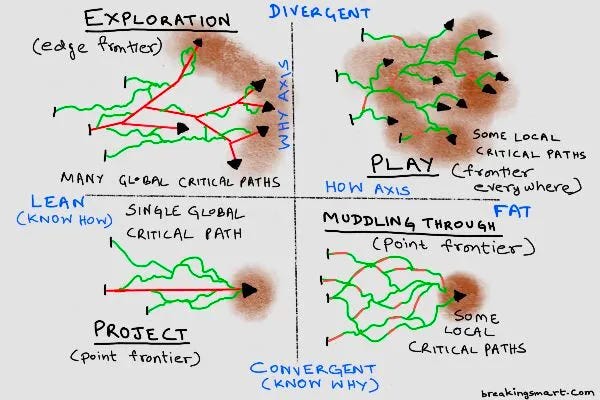
The current moment in crypto is somewhere between the top two quadrants.
Exploration: Where we know the value creation frontiers but don’t know the exact critical paths to reach those (eg we know Stablecoins and Payments have huge value potential, exactly how to build to deliver/capture there is still tbd)
Play: Where exactly what value creation looks like is still tbd, as is how to get there (re: protocol vs app value accrual debate)
In both these spaces, Speed to deploy/redeploy and Narrative Flexibility are valuable - no sense in continuing down a wrong path.
As is Upside Maximization - this is the reward for taking on the extra risk of committing capital in the midst of so much uncertainty.
As we move into the lower halves, where we know the “why” of doing (eg the real world value add is understood), transitioning into focusing on exchanging speed, flexibility, and upside for structure, risk mitigation, and process maturity constraints enable more of the world to engage with the value created by crypto.
Evaluating Institutional Behavior: Credibility, Readiness, Grade
With this groundwork done, we can start to connect our Definition, its relationship to constraints and behavior, to Institutional adjectives we see thrown around CT to get a sense of what *those too* might actually mean.
And use them to identify real opportunities and action sets.
In evaluating Institutional through this definitional frame, we can understand “Credibility,” “Readiness,” and “Grade” as orthogonal evaluation layers - different lenses through which we can examine to what degree an organization may *be institutional.*
In this light:
Credibility informs “who gets looked at”
Readiness determines “who can be engaged”
Grade indicates “who can be relied on”
Let’s dig a bit deeper into each.
Institutional Credibility
An organization is “Institutionally Credible” if it presents as safe and non-toxic for institutional engagement, clearing pre-diligence signalling filters.
Credibility is the legibility of institutional substance combined with trust signals that suggest a project may be worth an institutional actor’s investment in further diligence.
To the legibility piece, crypto organizations may have robust downside protection mechanisms in place - but if they aren’t documented and shared in a format that institutional actors can understand, they don’t support that crypto org’s Credibility.
To the trust signals piece, having leadership appear on a media channel or as a panel participant next to known companies/people, this may put the project on an institution’s radar for further exploration, even if that project wouldn’t actually be investible.
So we can see a crypto project could be Institutional Ready or even Grade, but not Credible - because it hasn’t surfaced relevant information in the right formats and channels to reach potential institutional partners.
And likewise, a crypto project can look Credible, but not be Ready or Grade - because somewhere along the line it doesn’t meet the Structural Eligibility, Downside Survivability, or Process Maturity criteria an institutional actor uses to determine whether engagement is possible.
Thus Credibility:
earns attention (at first)
lowers friction (to getting through initial evaluation)
facilitates access (deeper into engagement)
When crypto organizations aren’t Institutionally Credible, they’re filtered out before diligence even begins.
If they only have a thin layer of Credibility with little to no Readiness or Grade, they get filtered out during deeper evaluation.
Institutional Ready
An organization is “Institutional Ready” if all non-compensable engagement gates are satisfied, such that engagement can occur mechanically and legally without violating mandate, enforceability, liquidity, or downside-bounding constraints.
With engagement amongst institutional actors, there are certain inviolable rules that must be followed for business relationships to form and capital to flow.
These are the key Structural Eligibility constraints covered in our Definition.
Pilot programs have minimum deployments - if a DeFi platform’s market structure can’t handle that level of liquidity without outsized risk taking or slippage, it can’t participate.
Legal entities must be structured in jurisdictions where enforcement of consequences feels achievable.
Mandates allow for only certain risk profiles to be taken with funds.
Requirements like these create pass/fail gates; there’s no term reworking, relationship leveraging, or deal juicing that can get past these gates - you’re either Ready or you’re not.
And if you’re not, you’re done.
Thus, if Credibility gets you in the door and can help you move along the process, Ready keeps you from being stopped due to a mechanical constraint.
But even with sufficient Credibility and Readiness, the scope and scale of engagement can still be limited by Grade.
Institutional Grade
An organization is “Institutional Grade” if it is “institutional ready” and operates with sufficient reinforcement - accountability, risk discipline, operational resilience - to support durable, scalable trust.
This is where depth of Structural Eligibility, Downside Survivability, and Process Maturity determine whether a crypto project is “Institutional” enough to support actual engagement, not just Credibility and mechanical Readiness diligence filters.
A certain level of Grade is required to touch capital at all - just because your organization doesn’t completely fail mechanical/legal checks, doesn’t mean it’ll be deemed worthy of inclusion in even a Pilot program.
But Grade also scales into deeper engagements, moving into more integrated ops (Securitize x BlackRock BUIDL as an example), higher reliance (Anchorage is as qualified a custodian as its TradFi equivalents), and eventually capital scale.
Today, some crypto-native organizations (custodians, exchanges, RWA platforms, etc) are “Institutional Grade” enough for TradFi to engage in initial product integrations and pilot allocations.
But none currently operate at a depth of “Grade” that enables them to sit at the center of a major fund’s strategy, or serve as core infrastructure for a medium-to-large institutional operation.
That’s the reality of an industry currently working through the lower-right “Fat Convergent” quadrant of the above diagram; when it comes to TradFi applications, we know some Whys, but the most efficient and effective Hows are yet to be discovered (Process Maturity tbd).
Thus, the opportunity in Going Institutional isn’t simply to get BlackRock money now, but to participate in the deepening of the industry’s ability to operate under greater levels of constraint, expanding crypto’s global market penetration and taking a percentage of that 5-10 year down the line pie.
3 examples - Credible, Ready, Grade
Let’s see how this evaluation framework operates via an example of an overcollateralized DeFi Lending protocol we’ll call XYZ Lend.
Evaluating XYZ Lend through each of the above lenses, we can see how projects can be Credible but not Ready, Ready but not Grade, and finally what Grade can look like using these tools.
Looks Credible, Not Ready
XYZ lend has been live on mainnet for about 6 months. Collateralization ratios are conservative, liquidation mechanics are well designed, the team includes former Tradfi risk managers so parameters are set well.
The founder speaks on panels at all your favorite crypto conferences and shows he’s thought about what institutional engagement actually requires. Documentation’s clean. Blockworks, Messari, Defi Llama all have dashboards.
TVL is around $62m and trending up and to the right.
An analyst on the digital assets team at our favorite Wall Street firm Large Capital sees a clip of the founder speaking at the latest conference on LinkedIn and spends a few minutes taking a deeper look.
Surface-level Credibility screening passes - nothing toxic in the company’s comms/news record, Risk Documentation looks legible, the team signals substance.
One level deeper into the market structure check, though, and further engagement is already DOA.
The firm’s minimum pilot deployment is $10M, but putting $10m into XYZ’s largest pool would make their position 50% of the total pool liquidity - an unacceptable concentration risk as it overexposes them to Defi counterparty risk.
This example highlights how Institutional actors operate differently from crypto-native vibe-checking capital deployers.
There are hard-line rules that aren’t negotiable. Even if the team is solid, development and risk processes are at a solid level of maturity for their early stage, capital deployment is simply not on the table.
Is Ready, not Grade
4 months later, XYZ lend has continued to grind and TVL is now north of $343M.
Custody integrations are set up, legal entities are structured correctly in jurisdictions where enforcement is possible, liquidity depth looks adequate on the surface.
The XYZ team has also launched fixed-rate, fixed-term lending options with KYC-permissioned access so the allocator’s risk team can model bounded exposure with compliant counterparties.
So XYZ gets a few steps into Large Capital’s diligence process without failing any of the basic mechanical pass/fail gates.
But for the permissioned product, XYZ only has 12 active borrowers, the top three of which represent over 55% of outstanding loans.
Thus far, that hasn’t been an issue and XYZ’s risk modeling shows this amount of concentration *shouldn’t* be problematic in most market scenarios.
Large Capital’s team, however, isn’t comfortable underwriting the level of tail risk they’d take on deploying at their mandated size with the current counterparty set, so XYZ gets moved to the “revisit later” opportunity stack.
In this example, XYZ is “Institutional Ready” in that they’ve covered the key pass/fail Structural Eligibility Criteria to have a serious conversation with Large Capital’s digital assets team. This isn’t just a “looks good on the surface, falls apart in 5 minutes of research” project.
But at this stage, the parameters affecting Downside Survivability aren’t sufficient to meet the investment committee’s Downside Survivability standards, even for a pilot, so engagement at the capital deployment level is delayed.
Is Grade… enough for a Pilot
7 Months later, XYZ’s BD lead reaches back out to Large Capital with an update.
XYZ’s borrower base has grown from 12 to over 50 active counterparties, with the top 3 borrowers representing less than 17% of outstanding loans.
This was thanks to a more robust underwriting framework with standardized borrower eligibility criteria and independent credit evaluation that enabled broader onboarding without increased risk-taking.
Additionally, during a market-wide drawdown 3 months prior to the update, XYZ’s automated margin call system was stress-tested under real conditions. Collateral values dropped sharply, calls were triggered smoothly, and positions were cured within hours at zero loss to lenders.
With tail risk now structurally mitigated and real-world data bolstering projections and modeling, Large Capital’s investment committee approves the minimum deployment size for a 3-month pilot.
XYZ has now matured enough to enter the low end of the Grade scale.
Getting to 9-figure plus allocations will require more time and effort, but they’ve now opened the capital channels that build trust and operational knowledge to have a significant chance at reaching that outcome.
Now what?
The ultimate point is this: there’s room for crypto to embrace Tradfi, that was always part of the roadmap to building economic infrastructure that could become the “internet of money.”
And focusing on what makes Large Cap happy enough to deploy a few bucks into your chain or protocol is a good exercise in disciplined building and execution.
The above examples pointed towards working with Large Cap because that’s the next obvious intermediary to work with.
But the process of becoming an organization that Wall Street is willing to deploy with is one step towards their disintermediation - where does Large Cap get its funds, and what does it look like to work directly with them?
When we treat “Institutional” not as the latest meta hype cycle, not as a cash grab from The Anointed, but as a way of operating that increases the surface area with which the world can engage with crypto…
That’s a treasure worth sailing the seven seas to find.
This article was first published on X. Follow @cryptofreedman on X for more pieces like this.